
Global member - Philippines
Geography
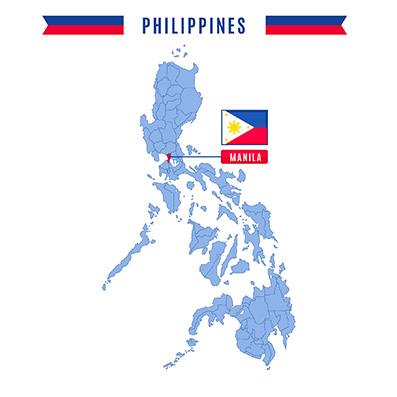
The Philippines is an archipelagic country located in Southeast Asia, situated in the western Pacific Ocean. It consists of over 7,600 islands, broadly categorized into three main island groups: Luzon, Visayas, and Mindanao. The country covers a total land area of approximately 300,000 square kilometres. Its strategic location makes it a natural gateway between the Pacific and Asian markets, within a few hours’ flight to major cities in East and Southeast Asia. The Philippines is also known for its diverse geography — featuring mountains, volcanoes, beaches, and extensive coastlines.
Population
As of 2023, the population of the Philippines is estimated at around 114 million, making it the 13th most populous countr in the world. A large portion of the population resides in urban areas, with Metro Manila being the political, economic, and cultural capital.
Language
- Official Languages: Filipino and English
- Regional Languages: Cebuano, Ilocano, Hiligaynon, Bicolano, Waray, and others The Philippines is one of the most linguistically diverse countries in the world, with more than 170 languages spoken nationwide. English is widely used in business, government, and education, making the country one of the largest English-speaking nations globally.
- Regular corporations: 25% (effective rate since 2021 under CREATE Law)
- For small corporations with net taxable income not exceeding PHP 5 million and total assets not exceeding PHP 100 million (excluding land): 20%
- Graduated tax rates range from 0% to 35%, depending on annual income.
- A maximum flat rate of 20% final tax applies to certain passive incomes such as interest, royalties, dividends, and capital gains.
- Value-Added Tax (VAT): 12% on sale of goods, properties, and services, and on importation.
- Percentage Tax: 3% for non-VAT registered businesses with annual sales below PHP 3 million.
- Excise Taxes: Imposed on selected goods like alcohol, tobacco, petroleum, and automobiles.
- Documentary Stamp Tax (DST): Applied to certain legal and financial documents.
Economic System
Mixed Market Economy – The Philippines operates under a mixed economic system combining free-market principles with government participation. The economy is driven by services, industry, and agriculture, with services accounting for the largest share of GDP.
Strategic Location and Investment Hub – Positioned in the heart of Asia, the Philippines serves as a key location for trade, logistics, and outsourcing. The country is part of the ASEAN Economic Community (AEC), providing access to a market of more than 600 million consumers.
Strong Service Sector – The Philippines is one of the world’s top destinations for Business Process Outsourcing (BPO), with major multinational companies establishing service centers in Metro Manila, Cebu, and Davao.
Growing Manufacturing and Infrastructure Development – Under initiatives such as the Build, Better, More program, the government has prioritized large-scale infrastructure development to enhance connectivity and economic competitiveness.
Tax System
Simplified and Reform-Oriented Tax System – The Philippines generally follows a progressive tax system governed by the National Internal Revenue Code (NIRC), as amended by the Tax Reform for Acceleration and Inclusion (TRAIN) and Corporate Recovery and Tax Incentives for Enterprises (CREATE) laws.
Corporate Income Tax (CIT)
Individual Income Tax
Indirect Taxes
Territorial and Incentive-Based System – The Philippines taxes income derived within its territory, with foreign-sourced income of resident citizens and domestic corporations also subject to tax. Registered enterprises under investment promotion agencies such as PEZA, BOI, and BCDA may enjoy tax holidays, special corporate tax rates, and customs incentives.
Double Taxation Agreements (DTAs) – The Philippines has entered into over 40 tax treaties with other countries to avoid double taxation and encourage cross-border investments. For reference, details can be found at the Bureau of Internal Revenue (BIR) website: www.bir.gov.ph.